
Understanding the Direct Method
The direct method, shows operating cash flows as the actual cash received from customers and the cash paid to suppliers, employees, and others:
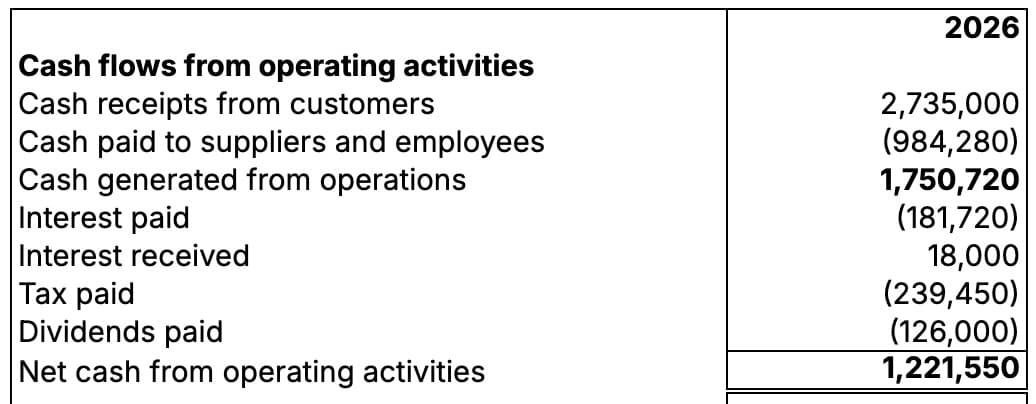
This contrasts with the indirect method, which reconciles accounting profit to cash flow through a series of adjustments.
Operating cash flows, under the direct method are typically presented in the following categories:
- Cash receipts from customers
- Cash paid to suppliers and employees
- Cash generated from operations (subtotal)
- Interest paid
- Interest received
- Dividends received
- Income tax paid
- Dividends paid (if classified as operating)
The cash generated from operations subtotal is important: it isolates the cash produced by trading alone, before the entity's financing and tax decisions are reflected. It is the direct method equivalent of the subtotal the indirect method reaches after adjusting profit for non-cash items and working capital, and both methods must arrive at the same figure.
Direct Method Cash Flow Statement Format
Bringing those line items together, a complete direct method cash flow statement takes the following form. The figures are those used throughout this article and in our example spreadsheet:
| Statement of cash flows for the year ended 31 December 2026 | Currency |
|---|---|
| Cash flows from operating activities | |
| Cash receipts from customers | 2,735,000 |
| Cash paid to suppliers and employees | (984,280) |
| Cash generated from operations | 1,750,720 |
| Interest paid | (181,720) |
| Interest received | 18,000 |
| Tax paid | (239,450) |
| Dividends paid | (126,000) |
| Net cash from operating activities | 1,221,550 |
| Cash flows from investing activities | |
| Acquisition of property, plant and equipment | (1,415,000) |
| Disposal of intangible assets | 10,000 |
| Net cash used in investing activities | (1,405,000) |
| Cash flows from financing activities | |
| Repayments of lease liabilities | (120,000) |
| Net cash used in financing activities | (120,000) |
| Net decrease in cash and cash equivalents | (303,450) |
| Cash and cash equivalents at 1 January | 450,000 |
| Cash and cash equivalents at 31 December | 146,550 |
What Counts as Cash and Cash Equivalents
Everything above the final two lines only makes sense once the bottom line is defined. Under IAS 7, cash comprises cash on hand and demand deposits, whilst cash equivalents are short-term, highly liquid investments that are readily convertible to known amounts of cash and subject to an insignificant risk of changes in value.
In practice this means:
- Investments generally qualify only where they have a short maturity from the date of acquisition, conventionally three months or less
- Equity investments are excluded, as their value is not fixed
- Bank overdrafts repayable on demand that form an integral part of the entity's cash management are included within cash and cash equivalents, rather than being shown as financing cash flows
- Movements between items that are themselves cash equivalents are not cash flows at all, and must not appear in the statement
Whilst the use of the direct method is encouraged by both IAS 7 and ASC 230, the indirect method remains more prevalent in practice due to its simpler preparation process.
You can download our comprehensive direct method example spreadsheet which demonstrates all calculations discussed in this article.
Please note
- IAS 7 and US GAAP ASC 230 are almost identical, with the only meaningful difference being the classification of interest and dividends. We'll discuss this below.
- When performing balance sheet reconciliations, debit transactions and balances are reflected in positive figures, and credit figures in negative. The sign for the elimination of closing balances, is the inverse.
Cash Receipts from Customers
Cash receipts from customers represent the primary cash inflow for most operating entities.
This figure is calculated by adjusting revenue for movements in trade receivables, as revenue is recognised on an accrual basis whilst cash flows represent actual receipts.
Formula for Cash Receipts from Customers
The basic formula for calculating cash receipts from customers is:
| Component | Amount |
|---|---|
| Revenue | xxx |
| Add: Opening trade receivables | xxx |
| Less: Closing trade receivables | xxx |
| Cash receipts from customers | xxx |
This adjustment recognises that:
- An increase in trade receivables (closing > opening) indicates that revenue exceeded cash collected, requiring a deduction from revenue
- A decrease in trade receivables (closing < opening) indicates that more cash was collected than revenue recognised, requiring an addition to revenue
Cash Paid to Suppliers and Employees
Cash paid to suppliers and employees represents the cash outflows for operating expenses.
This calculation is more complex than cash receipts as it requires multiple adjustments to derive the cash paid to suppliers and employees from profit before tax.
How to Calculate Cash Paid to Suppliers and Employees
The calculation starts with profit before tax and systematically adjusts for non-cash items and working capital movements:
Step 1: Start with profit before tax
Begin with the profit before tax figure from the income statement.
Step 2: Exclude revenue
Deduct revenue, as this is separately presented in cash receipts from customers.
Step 3: Add back non-cash expenses
Add back depreciation of property, plant and equipment, depreciation of right-of-use assets, amortisation of intangible assets and unrealised foreign exchange gains or losses.
These are accounting charges that do not involve cash outflows.
Depreciation and amortisation are the obvious cases, but they are rarely the only ones. Every line in profit or loss has to be interrogated, and the items below are the ones most often missed. Each is covered in more depth in our guide to cash flow statement adjustments.
| Item in profit or loss | Treatment in the suppliers and employees calculation |
|---|---|
| Depreciation, amortisation and impairment losses | Add back — no cash outflow |
| Movement in the allowance for expected credit losses | Add back an increase, deduct a decrease — a provision, not a payment |
| Bad debts written off | Add back — already removed in the receivables reconciliation |
| Inventory write-downs and movements in provisions | Add back the charge; the cash appears when the provision is settled |
| Gains and losses on disposal of assets | Reverse in full — the proceeds belong in investing activities |
| Share-based payment expense (equity-settled) | Add back — settled in shares, not cash |
| Share-based payment expense (cash-settled) | Add back the charge, then include the amount actually paid; the remeasurement of the liability is non-cash |
| Share of profit of associates and joint ventures | Deduct — equity-accounted income is not cash. Only dividends received are |
| Gain on a bargain purchase | Deduct — an acquisition-date accounting gain |
| Remeasurement of contingent consideration | Reverse — a fair value movement |
| Movement in unrealised intercompany profit | Reverse — a consolidation adjustment with no cash effect |
| Foreign currency translation reserve reclassified to profit or loss | Reverse — a recycling entry on disposal of a foreign operation |
| Deemed interest on preference shares and other financial instruments | Reverse and deal with as interest, per the entity's classification policy |
| Fair value adjustments on investment property and financial instruments | Reverse in full |
Step 4: Exclude items disclosed elsewhere
Add back the total interest expense, as well as any other finance costs. Under the direct method, these are not classified within cash paid to suppliers and employees but are instead presented separately.
Interest income (and other finance income) should be deducted as it forms part of profit but is also presented separately.
Realised foreign exchange gains and losses that relate to operating activities should remain in the calculation, whilst those relating to investing activities or financing activities, should be excluded to accurately reflect the actual cash flows in those activities. How these gains and losses arise on settlement is set out in our article on foreign exchange differences under IAS 21. Examples of these, per activity, include realised foreign exchange gains or losses on:
- Operating activities: operating expenses
- Investing activities: acquisition of property, plant and equipment
- Financing activities: settlement of a loan after revaluation
Step 5: Adjust for working capital movements
Apply the following working capital adjustments:
- Inventory: Opening inventory - Closing inventory (an increase in inventory represents cash used to acquire stock)
- Trade Payables: Closing payables - Opening payables (an increase in payables means less cash was paid than expenses incurred)
Putting all five steps together, the calculation for our example resolves as follows. Note how the figure never touches the expense lines directly — it is derived from profit before tax by stripping out everything that either did not move cash or belongs somewhere else in the statement:
| Cash paid to suppliers and employees | Currency |
|---|---|
| Profit before tax | 818,520 |
| Less: revenue (presented as cash receipts from customers) | (2,800,000) |
| Add: depreciation — property, plant and equipment | 550,000 |
| Add: depreciation — right-of-use assets | 88,000 |
| Add: amortisation of intangible assets | 100,000 |
| Add: bad debts written off | 12,700 |
| Less: gain on sale of intangible assets | (3,700) |
| Add: interest expense — long-term loan | 298,200 |
| Add: interest expense — lease liabilities | 180,000 |
| Less: interest income | (18,000) |
| Less: unrealised foreign exchange gain on loans | (240,000) |
| Add: realised foreign exchange loss on acquisition of PPE | 15,000 |
| Operating expenses on an accrual basis | (999,280) |
| Add: decrease in inventory (1,000,000 to 950,000) | 50,000 |
| Less: decrease in trade payables (280,000 to 245,000) | (35,000) |
| Cash paid to suppliers and employees | (984,280) |
Two lines in that table are worth pausing on. The unrealised foreign exchange gain of 240,000 on the loan is removed because no cash moved at all. The realised foreign exchange loss of 15,000 is added back here for a different reason: cash did move, but it moved on the settlement of a creditor for property, plant and equipment, so it belongs in investing activities alongside the asset it relates to.
This formula converts accrual-based expenses into actual cash payments by removing non-cash items and adjusting for timing differences in working capital accounts.
Working Capital Movements
Working capital adjustments follow a consistent logic: increases in assets (receivables, inventory) represent cash used, whilst increases in liabilities (payables) represent cash preserved.
The direct method requires these adjustments to be embedded within the calculation of gross cash flows rather than shown separately as in the indirect method.
VAT and Sales Tax
VAT causes more trouble under the direct method than under the indirect method, and for a structural reason: the two sides of the calculation are measured on different bases.
- Revenue and expenses in profit or loss are recognised exclusive of VAT
- Trade receivables and trade payables in the statement of financial position are carried inclusive of VAT
Netting a VAT-exclusive income statement figure against a VAT-inclusive balance sheet movement produces a number that is neither one nor the other. The indirect method largely hides this, because the working capital movement is presented as a single line. The direct method cannot hide it, because it claims to show the cash actually received from customers.
IAS 7 does not prescribe a treatment, and two presentations are both acceptable provided they are applied consistently:
- Present receipts and payments inclusive of VAT, with a single net line for VAT paid to the revenue authority (recommended)
- Present receipts and payments exclusive of VAT, with three separate line items
The second is the more informative presentation and the one most often examined. It is set out below at a 15% rate.
Splitting the Working Capital Movement
Because receivables and payables are VAT-inclusive, their movement has to be split into its VAT-exclusive portion and its VAT portion:
- VAT-exclusive portion = movement × 100/115
- VAT portion = movement × 15/115
The Three Line Items
| Line item | Calculation |
|---|---|
| Cash received from customers (excl. VAT) | Revenue + (opening receivables − closing receivables) × 100/115 |
| Output VAT received from customers | Revenue × 15% + (opening receivables − closing receivables) × 15/115 |
| Cash paid to suppliers and employees (excl. VAT) | Expenses + movement in inventory + (closing payables − opening payables) × 100/115 |
| Input VAT paid to suppliers | Purchases × 15% + (closing payables − opening payables) × 15/115 |
| VAT paid to the revenue authority | Opening VAT balance + output VAT on sales − input VAT on purchases − closing VAT balance |
Worked Example
Assume revenue of 2,000,000 excluding VAT, receivables of 460,000 rising to 575,000 (both VAT-inclusive), and a VAT control account balance of 40,000 rising to 65,000:
| Component | Currency |
|---|---|
| Revenue (excluding VAT) | 2,000,000 |
| Less: increase in receivables × 100/115 | (100,000) |
| Cash received from customers (excl. VAT) | 1,900,000 |
| Output VAT on revenue (2,000,000 × 15%) | 300,000 |
| Less: increase in receivables × 15/115 | (15,000) |
| Output VAT received from customers | 285,000 |
| Total banked from customers | 2,185,000 |
The check is straightforward: 1,900,000 × 1.15 = 2,185,000, which is the amount that actually cleared the bank.
VAT paid over to the revenue authority is then derived from the VAT control account itself, not from either of the above:
| VAT control account | Currency |
|---|---|
| Opening balance owing | 40,000 |
| Add: output VAT on sales | 300,000 |
| Less: input VAT on purchases | (180,000) |
| Less: closing balance owing | (65,000) |
| VAT paid to the revenue authority | 95,000 |
Other Operating Activities
Beyond cash receipts and payments for core operations, several other cash flows must be classified within operating activities, depending on the entity's accounting policy choice and the applicable accounting standard.
Interest Payments
Under current IAS 7, interest paid is one of a small number of items for which an accounting policy choice is permitted. It may be presented within either operating activities or financing activities, and whichever classification is chosen must be applied consistently from period to period.
However, with the introduction of IFRS 18 (effective 1 January 2027), the majority of entities need to classify interest paid as a financing activity, to match the new income statement categories. A limited exception applies to entities whose main business activity is financing (such as banks and certain financial institutions), for which interest paid is instead classified as an operating cash flow.
By contrast, under the US GAAP standard, ASC 230, interest paid must be classified as an operating cash flow.
From a practical perspective, determining interest paid for the direct method typically requires a reconciliation of the related balance sheet liability. This reconciliation considers the opening balance, the closing balance, and any non-cash movements that affected the account during the period, such as capitalised interest or foreign exchange differences.
The total cash payment made to settle a liability on which interest accrued usually comprises both a principal component and an interest component. For cash flow presentation purposes, the interest paid component is usually calculated as the lower of the total cash payment or the interest expense recognised for the period which related to the specific balance sheet account. In other words, we deem the interest to be paid first.
The principal portion of the payment represents the residual amount after deducting interest paid from the total cash outflow. This amount reflects the repayment of the underlying liability and is therefore usually classified within financing activities, consistent with its nature as a return of capital rather than a cost of operations.
In our example, interest paid comprises:
- Interest on long-term loans: 1,720
- Interest on lease liabilities: 180,000
- Total interest paid: 181,720
Capitalised Interest
Where borrowing costs have been capitalised into a qualifying asset under IAS 23, the interest expense recognised in profit or loss is no longer the whole story. The interest payable account has been credited with both the expensed and the capitalised amounts, so both must appear in the reconciliation or the balancing figure will be wrong.
| Interest payable reconciliation | Currency |
|---|---|
| Opening balance | 0 |
| Add: interest expense recognised in profit or loss | 250,600 |
| Add: interest capitalised to property, plant and equipment | 139,100 |
| Less: closing balance | (143,000) |
| Interest paid (balancing figure) | 246,700 |
Two points follow from this reconciliation, and both are regularly missed:
Interest payable is often hidden inside trade and other payables. In the example above the closing interest payable of 143,000 is presented within the trade and other payables line on the face of the statement of financial position. It has to be stripped out before that balance is used to calculate cash paid to suppliers, otherwise the same 143,000 is counted twice — once as an operating payable and once as accrued interest.
Capitalised interest that has been paid is still a cash outflow. IAS 7 paragraph 32 requires the total interest paid during the period to be disclosed, whether it was recognised as an expense or capitalised. The cash relating to the capitalised portion is normally presented within investing activities, as part of the cost of the asset it was capitalised to, so that the investing outflow reflects what the asset actually cost the entity in cash.
Interest Received
Under current IAS 7, interest received on cash balances and investments may be classified as either operating activities or investing activities, provided the classification is applied consistently. In practice, classification as operating activities is common where interest income arises from an entity's routine cash management activities and forms part of its operating return.
IFRS 18 also brings changes for interest received. For most entities, interest received is classified as an investing activity, consistent with its nature as a return on invested funds. A limited exception applies to entities whose main business activity is financing, such as banks and certain financial institutions, for which interest received is classified as an operating cash flow, as it arises from their primary revenue-generating activities.
With ASC 230, however, interest received must be classified as an operating cash flow, reflecting its inclusion in net income and the absence of any classification alternatives under US GAAP.
In applying the direct method, it is generally assumed that the interest component is received first, with any remaining cash inflow treated as a repayment of principal.
In our example, interest received of 18,000 represents 4% return on the opening cash balance.
Dividends Received
Dividends received from associates, joint ventures and other investments are cash flows, even though the profit that gave rise to them is not. Where an investment is equity accounted, the share of profit recognised in consolidated profit or loss must be removed as a non-cash item, and only the dividend actually received is presented as a cash flow.
Under IAS 7 dividends received may be classified as either operating or investing activities, applied consistently. Under IFRS 18 they will generally be classified as investing, other than for entities whose main business activity is investing. Under ASC 230, dividends received must be classified as operating.
The calculation is a reconciliation of the investment account:
| Investment in associate | Currency |
|---|---|
| Opening balance | xxx |
| Add: share of profit of associate | xxx |
| Add: share of other comprehensive income | xxx |
| Less: closing balance | (xxx) |
| Dividends received (balancing figure) | xxx |
Share-Based Payments
Share-based payment charges deserve a specific mention because their treatment depends entirely on how the award is settled.
An equity-settled award produces an expense with no cash outflow at all, and is simply added back. A cash-settled award produces an expense that is partly a remeasurement of the liability (non-cash) and partly an amount that will be paid in cash. The charge is added back in full and the amount actually paid is included within cash paid to suppliers and employees, derived from a reconciliation of the share-based payment liability. How the charge itself is measured, and why an award is classified as equity-settled or cash-settled in the first place, is set out in our guide to IFRS 2 share-based payment.
Cash-settled in one set of statements, equity-settled in another
The same award can be classified differently at different levels of a group. Where a parent grants its own equity instruments to the employees of a subsidiary, the arrangement is commonly equity-settled in the parent's consolidated statements but cash-settled in the subsidiary's own statements and in the statements of any intermediate group beneath the parent. When preparing a cash flow statement, always ask which reporting entity's statements you are preparing before deciding which classification applies.
Tax Payments
Income tax paid is always classified as operating activities under both IAS 7 and ASC 230, unless the tax can be specifically identified with financing or investing activities (which is rare in practice).
Before running the calculation, it is worth being clear on which balances tax moves through, because none of them holds the cash figure directly:
- Current tax payable is the liability for tax that has been assessed but not yet settled with the revenue authority. Where the entity has overpaid, the same balance appears instead as a current tax receivable
- Deferred tax is the tax effect of temporary differences between the accounting and tax bases of assets and liabilities. It absorbs part of the charge for the year, but never involves cash in that year
- Tax expense in profit or loss is the combined current and deferred charge for the period
Cash paid is what remains once the opening balances have been increased by the charge for the year and the closing balances have been taken back out. Both tax payable and deferred tax are credit balances, so they carry negative signs; the closing balances are deducted, and because the sign on an eliminated closing balance is the inverse, they appear as positive figures in the reconciliation below.
While some prefer to consider current and deferred tax separately, we prefer the simplicity of grouping the two together in the calculation for tax paid. With all other things being equal, both methods will yield the same answer.
Tax paid is calculated through a reconciliation of tax payable and deferred tax e.g.:
| Component | Amount |
|---|---|
| Opening tax payable | (4,000) |
| Opening deferred tax | (8,000) |
| Add: tax expense for the year | (240,450) |
| Less: closing tax payable | 7,000 |
| Less: closing deferred tax | 6,000 |
| Tax paid | (239,450) |
Dividends Paid
Dividends paid to shareholders are typically classified as financing activities under both IAS 7 and ASC 230, as they represent distributions to providers of equity capital rather than costs incurred in generating revenue.
However, IAS 7 permits an accounting policy choice, allowing dividends paid to be classified as either operating activities or financing activities, provided the classification is applied consistently. Many IFRS reporters currently present dividends paid within operating activities to assist users in assessing the entity's ability to generate sufficient operating cash flows to fund dividend distributions.
With the introduction of IFRS 18, this flexibility is removed. Under IFRS 18, dividends paid are required to be classified as financing activities, reflecting their nature as distributions to equity holders and aligning the statement of cash flows more closely with the new defined financing category in the statement of profit or loss. As a result, entities that currently present dividends paid within operating activities under IAS 7 will need to revise their classification on adoption of IFRS 18.
Under ASC 230, dividends paid must be classified as financing cash flows, with no alternative classification permitted.
Calculation of dividends paid
Dividends paid are typically calculated through a reconciliation of the dividends payable balance, considering opening and closing balances and dividends declared during the period.
In our example:
| Component | Amount |
|---|---|
| Opening dividends payable | 0 |
| Less: Closing dividends payable | 14,000 |
| Add: Dividends declared | (140,000) |
| Dividends paid | (126,000) |
Investing Activities
Note: The presentation of investing activities is identical under both the direct and indirect methods. The only difference between the two methods relates to the presentation of operating activities.
Investing activities represent cash flows from the acquisition and disposal of long-term assets and investments that are not included in cash and cash equivalents. Both the direct and indirect methods present these as gross cash outflows and inflows for each major class of asset.
In our example spreadsheet, we demonstrate the acquisition of property, plant and equipment through a balance sheet reconciliation. This reconciliation removes all non-cash movements such as:
- Depreciation charges
- Revaluation adjustments through other comprehensive income
- Unrealised foreign exchange movements
- Disposal carrying amounts
Investing Activities in Our Example
The example produces three asset reconciliations, and they illustrate three different outcomes:
Property, plant and equipment — a cash acquisition
| Property, plant and equipment | Currency |
|---|---|
| Opening carrying amount | 15,000,000 |
| Less: depreciation for the year | (550,000) |
| Add: revaluation of land through other comprehensive income | 200,000 |
| Less: closing carrying amount | (16,050,000) |
| Cash additions (balancing figure) | (1,400,000) |
The cash outflow presented in investing activities is 1,415,000, not 1,400,000. The difference is the realised foreign exchange loss of 15,000 incurred on settling the foreign currency creditor for the asset. That loss was removed from operating activities in the calculation of cash paid to suppliers precisely so that it could be grouped here, with the acquisition it relates to.
Right-of-use assets — no cash flow at all
Right-of-use assets rose from 3,200,000 to 4,362,000, with depreciation of 88,000 and new leases of 1,250,000 recognised during the year. The reconciliation balances to nil: every movement in the account was non-cash. The 1,250,000 is instead disclosed as a non-cash transaction, with its contra-entry in the lease liability.
Intangible assets — a disposal
| Intangible assets | Currency |
|---|---|
| Opening carrying amount | 800,000 |
| Less: amortisation for the year | (100,000) |
| Less: closing carrying amount | (693,700) |
| Carrying amount of asset disposed of (balancing figure) | 6,300 |
The reconciliation gives the carrying amount of 6,300, not the proceeds. Adding the gain on sale of 3,700 recognised in profit or loss gives cash proceeds of 10,000, and it is that figure — never the gain — which is presented in investing activities.
Two Traps Worth Knowing
Keep foreign currency creditors for capital items in a separate account. Where property, plant and equipment is bought on credit in a foreign currency, run the creditor through its own reconciliation rather than through trade payables. If it sits in trade payables, both the settlement and the exchange difference on it will be swept into operating activities, and the investing outflow will understate what the asset actually cost.
A finance lessor's receipts split into operating and investing, not financing. The lessee and lessor sides of a lease are not mirror images in the cash flow statement. For a lessee, the principal element of a lease payment is a financing outflow. For a finance lessor, the capital element of a lease receipt is an investing inflow, because it represents the recovery of an amount invested in the lease receivable. The finance income element follows the entity's interest received policy in both cases. There is no cash flow at all when the lease is first recognised on either side.
In our article on common adjustments, we also cover how to account for disposals of PPE and other fixed assets.
This section is not covered in full detail in this article as it does not differ between the direct and indirect methods. For comprehensive guidance on investing activities, please refer to our other resources.
Asset Acquisition transparency
Both the direct and indirect methods require gross presentation of acquisitions and disposals separately, rather than netting them. This provides users with better visibility of the entity's investment activities and capital allocation decisions. The limited exceptions where net reporting is permitted are set out under Required Disclosures below.
Financing Activities
Note: The presentation of financing activities is identical under both the direct and indirect methods. The only difference between the two methods relates to the presentation of operating activities.
Financing activities comprise cash flows that result in changes in the size and composition of the contributed equity and borrowings of the entity. Both methods present each major class of financing cash flow separately.
In our example spreadsheet, we demonstrate two key financing activities:
Lease Liability Payments:
Cash payments on lease liabilities are split between principal and interest components through a balance sheet reconciliation. The principal repayment of 120,000 is presented in financing activities, whilst the interest component of 180,000 is presented in operating activities (based on our accounting policy choice under IAS 7).
The reconciliation adjusts for new leases recognised during the period (1,250,000), which represents a non-cash transaction excluded from the cash flow statement.
Loan Repayments:
In our example, total cash paid on the loan was 1,720, which related entirely to interest payments. No principal repayment was made during the period. The loan balance increased due to capitalised interest and unrealised foreign exchange movements, which are non-cash adjustments.
Reconciliation of Liabilities Arising from Financing Activities
IAS 7 paragraphs 44A to 44E require entities to disclose changes in liabilities whose cash flows are, or would be, classified as financing activities. The purpose is to let users separate the part of the movement that consumed cash from the part that did not — which, in a year containing new leases or a large exchange movement, can be most of it.
The disclosure is conventionally presented as a table with one column per type of non-cash change:
| 2026 | Opening | Cash flows | New leases | Interest accrued | Exchange movements | Closing |
|---|---|---|---|---|---|---|
| Lease liabilities | 3,000,000 | (300,000) | 1,250,000 | 180,000 | — | 4,130,000 |
| Long-term loans | 4,958,000 | (1,720) | — | 298,200 | (240,000) | 5,014,480 |
| Total | 7,958,000 | (301,720) | 1,250,000 | 478,200 | (240,000) | 9,144,480 |
Of the 301,720 of cash flows in the table, only 120,000 — the principal element of the lease payments — is presented within financing activities. The remaining 181,720 is interest, presented within operating activities under the entity's IAS 7 policy choice. Where the two differ in this way, the split should be made clear in the note.
Points to observe when preparing the reconciliation:
- Long-term and short-term borrowings, and the current and non-current portions of lease liabilities, are each disclosed separately rather than as a single total
- Financial assets are included to the extent that their cash flows are, or will be, classified as financing — hedging instruments over borrowings being the usual case
- Non-cash changes arising from obtaining or losing control of subsidiaries are shown in their own column
- Where the reconciliation is combined with movements in other assets and liabilities, the financing liability changes must still be identifiable separately
Other financing cash flows that may be presented include proceeds from issuing shares or other equity instruments, payments to acquire or redeem the entity's shares, proceeds from issuing debentures or other borrowings, and repayments of amounts borrowed.
This section is not covered in full detail in this article as it does not differ between the direct and indirect methods. For comprehensive guidance on financing activities, please refer to our other resources.
Consolidated Cash Flow Statements
The direct method becomes considerably harder in a group, for one reason above all others: balances move for reasons other than cash. What follows is the direct method view of that problem; the full treatment, including group-specific non-cash adjustments, foreign operations and the group disclosure requirements, is set out in our guide to consolidated cash flow statements. A subsidiary acquired mid-year brings in receivables, inventory and payables that were never bought or sold by the group, and a subsidiary disposed of takes them away again. Every reconciliation discussed so far needs additional lines to strip those movements out.
| Reconciliation | Additional lines required in a group |
|---|---|
| Receivables, inventory, payables | Balances acquired with a subsidiary; balances disposed of with a subsidiary; exchange differences on translation |
| Property, plant and equipment | Assets acquired with a subsidiary at fair value; assets disposed of with a subsidiary |
| Tax | Current and deferred tax balances acquired and disposed of |
| Borrowings and leases | Liabilities assumed on acquisition; liabilities derecognised on disposal |
Acquisition of a Subsidiary
Under IAS 7 paragraph 39, the aggregate cash flow arising from obtaining control of a subsidiary is presented as a single line within investing activities, measured net of the cash and cash equivalents acquired:
| Acquisition of subsidiary | Currency |
|---|---|
| Net assets acquired at fair value | (800,000) |
| Goodwill recognised | (25,000) |
| Non-controlling interest recognised | 160,000 |
| Total consideration | (665,000) |
| Add: cash and cash equivalents acquired | 15,000 |
| Add: deferred and contingent consideration not yet settled | 200,000 |
| Net cash outflow on acquisition | (450,000) |
Because that single line already accounts for every asset and liability acquired, none of them may appear anywhere else in the statement. IAS 7 paragraph 40 requires disclosure of the total consideration, the portion settled in cash and cash equivalents, the amount of cash and cash equivalents in the subsidiary acquired, and the other assets and liabilities acquired summarised by major category.
Disposal of a Subsidiary
The mirror image applies on losing control, with one counter-intuitive feature. Where the subsidiary disposed of was carrying a bank overdraft, that overdraft leaves the group along with it, so the group's net cash position improves by the amount of the overdraft:
| Disposal of subsidiary | Currency |
|---|---|
| Net assets derecognised | 1,040,000 |
| Goodwill derecognised | 25,000 |
| Non-controlling interest derecognised | (260,000) |
| Gain on disposal recognised in profit or loss | 45,000 |
| Total consideration | 850,000 |
| Add: bank overdraft of subsidiary derecognised | 30,000 |
| Net cash inflow on disposal | 880,000 |
Note also that the 45,000 gain on disposal is a non-cash item recognised in consolidated profit, and must be removed in the calculation of cash paid to suppliers and employees. Where the subsidiary was a foreign operation, any foreign currency translation reserve recycled to profit or loss on disposal must be removed on the same basis. Where part of the interest is retained and remeasured to fair value, that remeasurement is likewise non-cash.
Changes in Ownership Without a Loss of Control
Where an interest in a subsidiary is increased or reduced but control is retained, no gain or loss arises: the transaction is accounted for in equity. The cash flow is presented within financing activities, and equals the change in ownership consideration adjusted for the movement in non-controlling interest. A rights issue taken up by the non-controlling shareholders is a cash inflow to the group and is presented on the same basis.
Dividends Paid to Non-Controlling Interests
Dividends paid by a subsidiary to its non-controlling shareholders are real cash flows out of the group and are presented within financing activities. They are frequently not disclosed directly and must be derived from the non-controlling interest reconciliation:
| Non-controlling interest | Currency |
|---|---|
| Opening balance | xxx |
| Add: total comprehensive income attributable to NCI | xxx |
| Add: NCI recognised on acquisition of a subsidiary | xxx |
| Less: NCI derecognised on disposal of a subsidiary | (xxx) |
| Add or less: changes in ownership interest and rights issues | xxx |
| Less: closing balance | (xxx) |
| Dividends paid to NCI (balancing figure) | xxx |
Foreign subsidiaries
The cash flows of a foreign subsidiary are translated at the exchange rates ruling at the dates of the cash flows, with average rates permitted as an approximation. The resulting difference does not belong in any of the three activity categories — it is presented as a separate reconciling line, as explained in our article on foreign exchange in cash flow statements.
Non-Cash transactions
Non-cash investing and financing transactions are excluded from the cash flow statement but must be disclosed separately elsewhere in the financial statements under both IAS 7 and ASC 230.
These transactions represent significant investing or financing activities that do not directly affect cash flows but are important for understanding the entity's financial position and activities.
IAS 7 paragraph 44 gives the common examples:
- Acquiring an asset by assuming a directly related liability
- Acquiring a right-of-use asset by entering into a lease
- Acquiring an entity by means of an equity issue
- Converting debt to equity
To these can be added the items that arise most often in practice: revaluations recognised through other comprehensive income, unrealised exchange differences on foreign currency liabilities, dividends declared but not yet paid, and share-based payments settled in equity.
In our example, the 1,250,000 of new leases recognised during the year is the sole non-cash transaction. It appears in both the right-of-use asset reconciliation and the lease liability reconciliation, cancels out entirely, and would materially mislead a user of the accounts if it were not disclosed — the group added 1,250,000 of assets and 1,250,000 of debt without a penny of cash moving.
Required Disclosures
Three disclosures are required of every entity applying IAS 7, whichever method it uses, and are easily overlooked when the focus is on getting the statement itself to balance.
Components of Cash and Cash Equivalents
Paragraph 45 requires the components of cash and cash equivalents to be disclosed, together with a reconciliation to the equivalent amounts reported in the statement of financial position. The policy adopted in determining the composition must also be disclosed, and any change in that policy is reported under IAS 8.
| Components of cash and cash equivalents | 2026 | 2025 |
|---|---|---|
| Cash on hand and balances with banks | 40 | 25 |
| Short-term investments | 190 | 135 |
| As previously reported | 230 | 160 |
| Effect of exchange rate changes | — | (40) |
| Cash and cash equivalents as restated | 230 | 120 |
Restricted Cash
Paragraph 48 requires disclosure, with commentary from management, of significant cash and cash equivalent balances held by the entity that are not available for use by the group. The classic case is a foreign subsidiary sitting on a large cash balance in a jurisdiction with exchange control restrictions: the balance is genuinely cash, and genuinely consolidated, but the parent cannot get at it.
Cash Flows of Discontinued Operations
Where an operation has been discontinued, the net cash flows attributable to its operating, investing and financing activities must be disclosed, either in the notes or on the face of the statement. This allows a user to strip out the cash flows that will not recur.
Reporting on a Net Basis
The general rule under IAS 7 is that receipts and payments are reported gross. Paragraphs 22 to 24 provide two exceptions where net reporting is permitted:
- Cash flows received or paid on behalf of customers, where the flows reflect the customer's activities rather than the entity's — rents collected on behalf of property owners, or funds held for clients, being typical examples
- Cash flows for items with a quick turnover, large amounts and short maturities — such as advances and repayments on short-term borrowings with a maturity of three months or less, or credit card customer balances
Outside these cases, offsetting a receipt against a payment removes exactly the information the direct method exists to provide.
Encouraged Disclosures
Paragraph 50 encourages, without requiring, additional information that helps users understand the entity's financial position and liquidity. The most useful in practice are a split between the cash flows that increase operating capacity and those needed merely to maintain it, and cash flows disaggregated by reportable segment.
Conclusion
The direct method of preparing a cash flow statement provides superior transparency about an entity's cash generation and utilisation patterns by presenting major classes of gross cash receipts and payments. Whilst more complex to compile than the indirect method for operating activities, the direct method offers significant analytical benefits to users seeking to understand cash flow dynamics.
Both IAS 7 and ASC 230 encourage the use of the direct method, recognising its value in providing more useful information to financial statement users. The key difference between the standards lies primarily in classification requirements, with ASC 230 requiring operating classification for interest and dividends received, whilst IAS 7 permits more flexibility.
For clarification, guidance, or feedback on our article, please reach out to us at insight@leash.co.za.